Earlier this year, Kate Bush made history as the artist with the longest time between number one songs on the UK singles chart when her 80s single ‘Running up That Hill (A Deal with God)’ experienced a resurgence in popularity after featuring in Netflix’s Stranger Things. It felt strange to hear the 1985 track nestled amongst the brash beats of modern pop radio. The reality, however, is that we’ve been hearing melodies from the 80s, 90s, and earlier on the radio more than ever in recent years. This is about the growing popularity of interpolations in modern pop music.
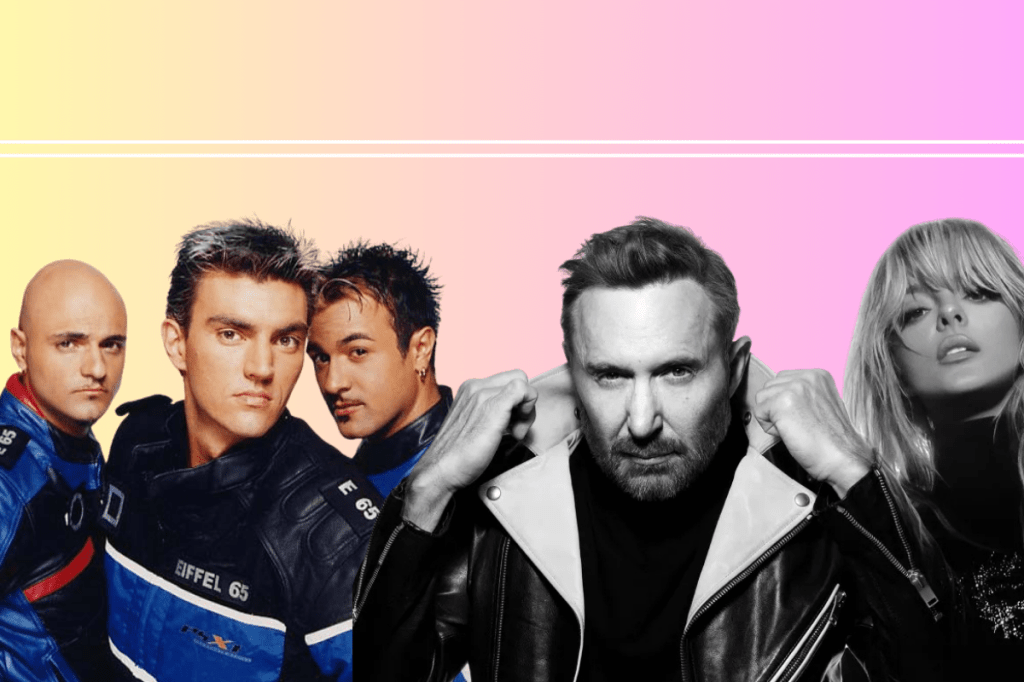
One needn’t look further than September’s Official Singles Chart to see what I mean. Standing proudly atop the chart is David Guetta and Bebe Rexha’s ‘I’m Good (Blue)’, which unabashedly interpolates the hook of Eiffel 65’s hit ‘Blue (Da Ba Dee)’, which held the number one spot exactly 23 years prior.
Interpolating is when one song takes musical material from another – typically a melody – without using the original recording, which would constitute a sample. Dua Lipa, for example, samples Lew Stone & the Monseigneur Band and Al Bowlly’s ‘My Woman’ on ‘Love Again’; but interpolates the bassline and melody from INXS’ ‘Need You Tonight’ on her single ‘Break My Heart’. Other songs both sample and interpolate, as Yung Gravy’s ‘Betty’ does with Rick Astley’s ‘Never Gonna Give You Up’.
Interpolations in pop music are nothing new; to quote songwriter Jamie Hartman, they’re “as old as the hills.” There is evidence, however, that they have increased in popularity in recent years. Nate Sloan, a musicologist and co-host of the SwitchedOn Pop podcast, analysed the Billboard Hot 100 year-end charts of the 2010s. He found that between 2010 and 2015, just 10% of songs credited an interpolation Between 2016 and 2021, however, this number doubled to 20%.
Sloan’s findings make sense when considering the biggest hits of the beginning of the latter period, especially in 2017. Some of the most prominent hits of the year; including ‘Shape of You’ by Ed Sheeran, ‘Look What You Made Me Do’ by Taylor Swift, and ‘Feel It Still’ by Portugal. The Man; all prominently feature interpolations of past hits. So, is there a reason behind this seeming surge in popularity?
Interpolations in songs can be broadly categorised into two camps. The first includes cases where a song incorporates elements of another song’s melody or even just its vibe and credits the original because of it. The second consists of songs where the interpolation is the core of the song itself, as if the song was made with the express intention of flipping the original.
One possible explanation for the apparent rise in songs with interpolations might simply be that interpolations are being credited more often than in the past. High-profile cases of singers being sued for plagiarism has led to songwriters and performers being more careful when deciding whether to include an additional songwriting credit. Notable cases include Taylor Swift being sued for the alleged similarities between ‘Shake It Off’ and the 3LW song ‘Playas Gonna Play’, and Katy Perry going to court for supposedly stealing the eight-note riff that opens her 2014 single ‘Dark Horse’ from rapper Marcus Gray. In a particularly infamous example, Marvin Gaye’s family sued Robin Thicke and Pharell Williams for cribbing the vibe of Gaye’s ‘Got to Give It Up’ for their 2013 hit, ‘Blurred Lines’.. Despite the lack of direct interpolation in Thicke’s record, cases such as these have driven artists to be more cautious than before, even giving co-writing credits when no melodic information is taken. Recent examples include Beyoncé crediting Robin S. on ‘Break my Soul’, and One Republic crediting Young Folks on their recent hit, ‘I Ain’t Worried’. When artists do take legal action, even if the interpolating artist wins the lawsuit (as in the cases of both Swift and Perry), the legal expenses and negative media coverage are simply not worth the hassle for major label artists who can afford to fork over a share of the publishing revenue.
On the other hand, the practice of clear, intentional interpolation is becoming more prevalent. A recent phenomenon is that of artists selling their back catalogue to music publishers, as Bob Dylan recently did to Sony for an estimated $150 million. These publishing companies have made significant financial investment in the rights to these songs, and in order to make back that value they must find a way to generate renewed interest in these records. Interpolation is one way of doing so.
Publishing companies now set up songwriting camps with the intention of finding writers to revamp a song from their catalogue and sell it to a new artist. The strategy brings the company double revenue streams: one from the new song and its royalties; and another from new interest in the original record, which the publishing company also owns and can derive revenue from. One such camp was organised in June 2021 by publishing company Primary Wave, which acquired the rights to a swathe of hits by performers such as Stevie Wonder and Bob Marley and sent them out to attending writers ahead of the camp. Resultantly, Dan Wilson’s ‘Closing Time’ (the rights to which Primary Wave had acquired earlier that year) eventually manifested in the Iann Dior track ‘Thought It Was’, a collaboration with Machine Gun Kelly and Travis Barker.
So, if you’ve noticed a peculiar sense of déjà vu when listening to the radio (or your personally-curated Spotify playlist because, let’s be honest, it’s 2022) recently, you’re not alone. Interpolations do seem to be on the rise, and are being encouraged behind the scenes in ways you might not even be aware of. While it’s possible to take a cynical look at this label-driven means of songwriting, it is impossible to deny their effectiveness in generating hits. As songwriter Jennie Owen Young put it, “no new hook will ever be as hooky as a hook that has already hooked you.” Just ask David Guetta.

 Dedicated
Leave a comment